- The Banking Brief
- Posts
- 🏦African Bank CEO exits. M-pesa hits 40 million customers.
🏦African Bank CEO exits. M-pesa hits 40 million customers.
Inside: Capitec Launches AI Tool

Elly Ngoma
March 09, 2026
When the top job only lasts five years
Plus: M-Pesa hits 40 million Kenyan users, Capitec's AI knows what you need before you say it, and why Syria's replacing MTN with a brand-new operator.
IN TODAY'S EDITION
M-Pesa crosses 40 million monthly active users in Kenya as platform marks 19 years
African Bank's CEO steps down after shepherding R37bn in acquisitions
Capitec cuts call times 18% with AI that reads your mind (well, your data)
MTN finally exits Syria as Damascus opens bidding for replacement operator
Kenya banks park cash in government bonds while Nedbank deal forces institutional exits
M-Pesa hit 40 million monthly active customers in Kenya on 6 March 2026, marking 19 years since launch. The platform processed 21.9 billion transactions worth KES 20.2 trillion in the six months to September 2025, contributing over 40% of Safaricom's total service revenue. Growth surged from 9.8 million users in 2012 to 40 million in 2026, accelerating during the pandemic as digital payments replaced cash. Kenyan Wall Street
African Bank CEO Kennedy Bungane resigned effective 6 March 2026 after five years leading the lender's transformation from mono-line unsecured credit into diversified banking. Zweli Manyathi, who led business and commercial banking and oversaw the Grindrod and Sasfin acquisitions, steps in as interim CEO while the board searches for a permanent replacement.
Capitec launched Pulse, an AI tool that gives call centre agents real-time context about a client's problem before the conversation even starts. Testing showed 18% faster call resolution (26% overall performance lift) by analysing payment data, app diagnostics, and risk signals the moment a customer contacts support.
Syria opened international bidding to replace MTN with a new mobile operator after MTN abandoned operations in 2021 following regulatory disputes. The 20-year licence gives the winner 75% of the business, with Syria's sovereign fund holding 25%. Tender closes 15 June 2026.
Absa Bank Kenya shifted 19% more funds into government securities as loan demand stayed flat in 2025. Government paper hit KES 115bn ($890m) while customer loans grew just 1% to KES 312bn ($2.4bn). Digital banking now handles 94% of transactions, propping up fee income as interest margins compressed 6%.
Nedbank's NCBA deal could force Kenyan institutions into all-cash exits if they can't legally hold offshore shares. Some pension funds and insurers face strict limits on foreign-listed securities, meaning they'll get cash instead of Nedbank stock in the 66% acquisition.
LEAD TRANSACTIONS
M-PESA hits 40 million users - quadruple growth since 2012
Catch up: Safaricom announced on 6 March 2026 that M-Pesa crossed 40 million monthly active customers in Kenya, marking 19 years since launch. In the six months to September 2025 alone, M-Pesa processed 21.9 billion transactions worth KES 20.2 trillion - more value in six months than Kenya's entire annual GDP of roughly KES 15 trillion. The platform evolved from simple person-to-person transfers in 2007 into a full digital financial ecosystem handling merchant payments (Lipa na M-Pesa), credit (Fuliza overdraft, KCB M-Pesa loans), savings (Ziidi Money Market Fund), and international transfers (M-Pesa Global). M-Pesa now contributes over 40% of Safaricom's total service revenue, hitting KES 161.3 billion in FY2025.
Behind the scenes: Growth accelerated from 9.8 million users in 2012 to 40 million in 2026, with the pandemic triggering a surge as digital payments replaced cash. Financial inclusion in Kenya jumped from 26% in 2007 to 84% in 2021, with M-Pesa accounting for most of that growth. The platform leapfrogged traditional banking entirely - millions of Kenyans went straight from cash to mobile money without ever opening a bank account. Network effects locked in dominance: when everyone uses M-Pesa, switching to a competitor becomes nearly impossible for vendors, suppliers, and customers who rely on the platform daily.
So what? The challenge now is sustaining growth in a market nearing saturation. With 40 million users in a country of 55 million people, M-Pesa has penetrated nearly every adult with a mobile phone. Future revenue must come from deeper engagement (more transactions per user), higher-value services (credit, investments), or expansion beyond Kenya - where M-Pesa operates in Tanzania, Mozambique, Lesotho, Ghana, and Ethiopia but hasn't replicated Kenya's dominance. The risk is monetising 40 million users without eroding trust through excessive fees, aggressive credit products, or bloated features that turn a simple money transfer service into resented bloatware.
African Bank CEO Exits

Setting the scene: Kennedy Bungane walked into African Bank in April 2021 carrying the weight of history. The lender had collapsed in 2014, been placed under curatorship, and emerged two years later as a mono-line unsecured lender vulnerable to the same mistakes. Five years later, on 6 March 2026, he resigned with no explanation - just a terse Friday afternoon SENS announcement. Bungane left behind a bank barely recognisable from the one he inherited: UBank, Grindrod Bank, and chunks of Sasfin's business absorbed; net advances up 15% to R37.1bn; business and commercial banking surging 49%; non-interest income up 39% to R2.1bn. The Excelerate Strategy (the bank's five-year transformation plan) turned African Bank from unsecured consumer credit into a diversified retail and business lender serving multiple segments.
What’s Next? Zwelibanzi "Zweli" Manyathi, who ran business and commercial banking and oversaw the Grindrod and Sasfin integrations, steps in as interim CEO while the board hunts for a permanent replacement. Manyathi knows the playbook - he built large chunks of it - but he inherits a bank now competing head-on with Standard Bank, Absa, Nedbank, and FirstRand across business banking, transactional accounts, and multi-segment lending. African Bank's edge was serving customers the big four ignored. As it scales up, that differentiation thins. Not to mention the integration risk is very real: different systems, different cultures, different risk appetites across acquired businesses.
So what? The question every transformation story eventually faces: does the strategy survive the strategist? Watch how African Bank positions itself over the next 12 months. If it leans into niche segments - underserved SMEs, specific regional markets - that signals confidence in differentiation. If it competes on price or chases the same customers as the big four, that's a red flag. The thing is that diversification only works if the bank can serve markets incumbents don't want or can't reach profitably or scale. Bungane built the machine. Whether Manyathi can run it better - or if the board brings in fresh leadership - will determine if the transformation sticks or stalls. Either way, it’s a story worth following.
Capitec’s New AI
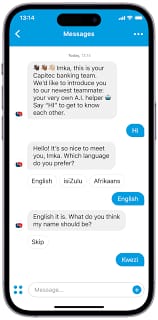
Catch up: Capitec's new Pulse tool doesn't wait for you to describe what's wrong. The moment you contact support through the banking app, the system pulls signals from across Capitec's infrastructure - payment data, app diagnostics, risk indicators - and hands agents a complete picture before you say a word. Testing over three months showed agents using Pulse cut call handling times by up to 18%, translating to a 26% overall performance improvement. Built in-house using Amazon Connect and AWS infrastructure, Pulse only activates when you reach out for help and shuts down when the interaction ends. No background profiling, no always-on surveillance - just event-triggered context delivery that runs within existing privacy policies.
This is about cost efficiency as much as customer satisfaction. Cutting 18% off call times means fewer agents handling the same volume, or the same agents handling more volume. Either way, Capitec's contact centre just got more productive. AI-powered agent assist isn't new - vendors like Genesys, Five9, and Salesforce sell similar tools - but Capitec's move is noteworthy because it's homegrown, Africa-focused, and deployed at scale in a market where most banks still route you to call centres where you repeat your account number three times.
So what? The privacy angle cuts both ways. Capitec says the tool is event-triggered and time-limited, which sounds reassuring until you remember that "event-triggered" means Pulse scans your payment history, app behaviour, and risk profile every time you call. That's a lot of data flowing through a contact centre agent's screen. The banks that figure out how to use AI for real-time problem-solving without creeping out customers will own customer service in the next five years. Capitec's betting that speed and convenience matter more than privacy concerns - and they're probably right for most customers. But watch for blowback if the tool surfaces sensitive data agents don't need, or if customers realise just how much Capitec knows about their financial lives every time they dial for help. You can read their CTO’s blog post on why it can’t be copied here.
WHAT TO WATCH
Date | Event | Why it matters |
|---|---|---|
15 June 2026 | Syria mobile licence tender closes | Winner replaces MTN; signals appetite for state-heavy telecom markets |
Mid-2026 | Nedbank-NCBA deal closure | Reshapes East African banking landscape; tests cross-border M&A execution |
Ongoing | Kenyan lending recovery | Weak loan growth pushing banks into government securities; timing of recovery unclear |
ON THIS DAY

10 March 2009 - Seventeen years ago this week, Zimbabwe abandoned its own currency after hyperinflation hit 89.7 sextillion percent (that's 21 zeros). The Reserve Bank of Zimbabwe had been printing Z$100 trillion notes, but by the time they hit circulation, you needed a wheelbarrow full to buy bread. Finance Minister Tendai Biti announced that Zimbabwe would adopt a basket of foreign currencies, primarily the U.S. dollar and South African rand, effectively admitting the Zimbabwe dollar was worthless. Shops immediately started pricing goods in dollars. ATMs switched overnight. The currency that had circulated since 1980 disappeared from daily life within weeks.
Feedback? Tips? Questions or Suggestions? Just hit reply.