- The Banking Brief
- Posts
- 🏦Banking Brief: Big 4 Banks Post 135bn in Earnings. Kenny Fihla's R98bn bonus and SA's 1.1% growth
🏦Banking Brief: Big 4 Banks Post 135bn in Earnings. Kenny Fihla's R98bn bonus and SA's 1.1% growth
The 5 Big Stories You Missed

Elly Ngoma
March 15, 2026
Happy Sunday. Economists threw a parade because South Africa's economy grew 1.1% in 2025 - our fastest pace in three years. In context: if you earned R80,000 last year and got a 1.1% raise, you'd pocket an extra R880. That buys you roughly three months of electricity, or maybe half a tank of petrol if oil prices cooperate. Not exactly champagne-popping territory. The economy might be a R101.10 loaf of bread instead of R100, but after you subtract population growth (1.2%) and inflation (4.5%), most households are holding less bread than last year.
In other news, if you enjoy The Banking Brief, please whitelist this email and move it to your primary inbox. We promise to keep making economic data slightly less depressing.
Okay, back to regular reporting.
The Most Important Stories This Week
Big four banks posted R135bn+ combined earnings for 2025, with geographic diversification across Africa driving superior results. Standard Bank led with R49.2bn (up 11%), nearly R20bn from its 20-country Africa portfolio. FirstRand: R23.2bn interim (up 11%). Absa: R24.8bn (up 12%). Nedbank: R17.2bn (up just 2%) - still over 80% dependent on South Africa's 1.1% GDP growth while East/West Africa economies expand 5-7% annually.
Absa paid CEO Kenny Fihla R148m for six-and-a-half months in 2025, including a R98.5m buyout package (R20.7m cash, R77.7m shares) to compensate for unvested incentives he forfeited when leaving Standard Bank. His total package: R6.3m fixed pay, R23.3m short-term incentives, R20m long-term award. There is a precedent: Nedbank paid Jason Quinn (Absa's former CFO) R71.9m in buyout awards when he jumped ship in 2024. South Africa's banks have cycled through more CEOs in the past decade than global peers, making buyouts standard rather than exceptional.
South Africa's GDP grew 1.1% in 2025 - the fastest pace since 2022 (2.1%) - driven by agriculture, trade, and finance industries. Q4 2025 expansion was 0.4%, slightly beating the 0.3% forecast. The economy has underperformed for over a decade, averaging less than 1% annual growth due to electricity shortages and logistics breakdowns. Treasury projects 1.6% growth for 2026, rising to 2% by 2028 as reforms gain traction.
Pepkor is seeking a banking licence as Africa's largest clothing retailer (brands include Ackermans, PEP, Dunns) plans to launch financial services. The company is searching for a "money chief" to lead the banking push, aiming to serve its massive customer base of price-sensitive consumers across southern Africa.
Remgro expects interim earnings to jump 36-41% for the six months to December, driven by holdings in Mediclinic, Heineken, RCL Foods, OUTsurance, and TotalEnergies. The Johann Rupert-controlled investment vehicle sold 52m FirstRand shares for R4.88bn (average R93.87/share) in February-March, adding strategic cash reserves. Full results drop 25 March.
LEADING TRANSACTIONS
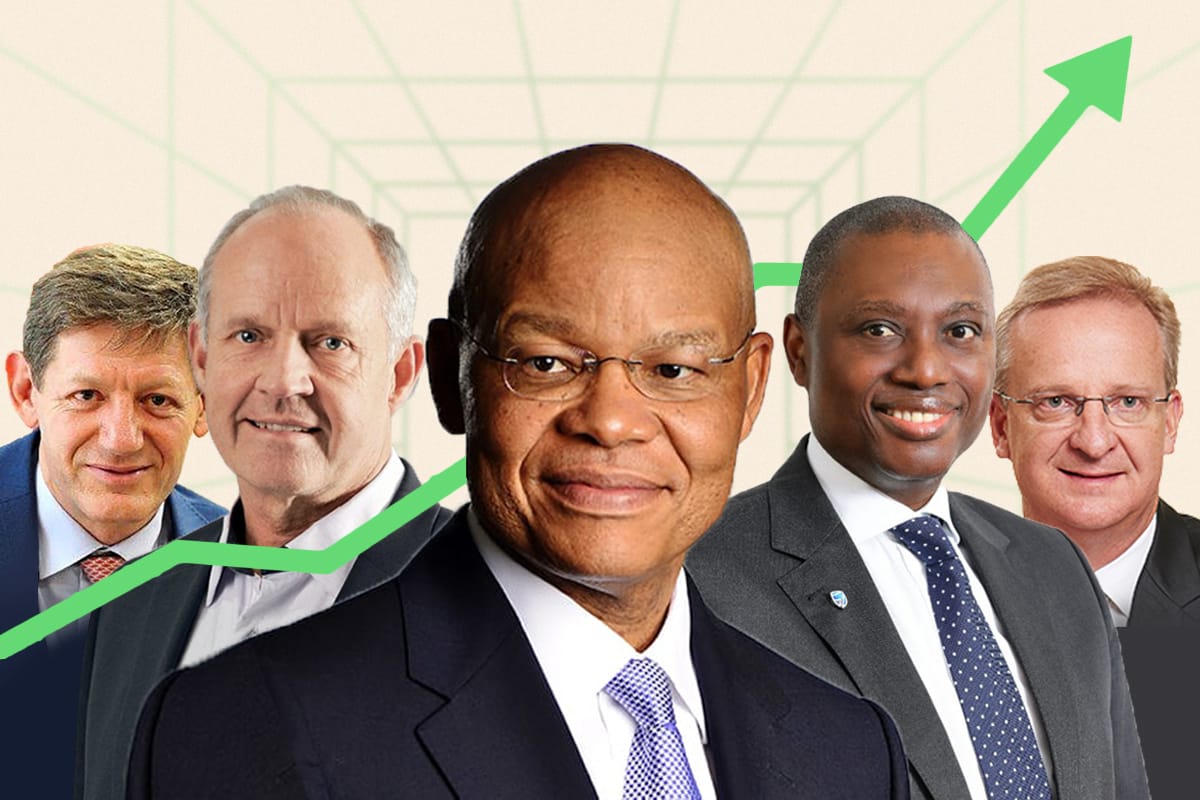
Big Four Banks Post 135 Billion in Earnings
South Africa's big four banks reported combined headline earnings of over R135bn for 2025, with the banks that spread their bets across Africa delivering the strongest results. Standard Bank led the pack with R49.2bn in earnings (up 11%), nearly R20bn of which came from its 20-country Africa portfolio outside South Africa. FirstRand pulled R23.2bn in its half-year to December (up 11%), while Absa posted R24.8bn full-year earnings (up 12%). Nedbank lagged with R17.2bn (up just 2%), largely because over 80% of its earnings still come from South Africa - more on that later - a market growing at 1.1% while East and West African economies clock 5-7% annual GDP expansion.
The story here is geographic diversification paying dividends: Standard Bank's Africa regions delivered a 20.4% return on equity, miles ahead of the South African market's returns. ROE - Return on equity is a way of measuring how much profit a bank generates for every Rand shareholders invested in it. When Standard Bank reports 20.4% ROE from its Africa operations, it means for every R100 of shareholder capital deployed in Nigeria, Kenya, Ghana, etc., the bank is generating R20.40 in annual profit. Which is good because anything above 15% is considered pretty strong for a bank. Absa's Africa operations (outside South Africa, Kenya, and Ghana) now contribute 31% of group earnings, up from practically zero a decade ago. FirstRand's broader Africa portfolio - we’re talking about Nigeria, Ghana, Mozambique, Zambia, Botswana - generated R2.6bn with a 20.4% ROE (Return on equity). So what’s happening is, if you're stuck in South Africa, you're stuck with 1.1% GDP growth and 30%+ unemployment which constrains loan book expansion. If you've built scale in Lagos, Nairobi, or Accra, you're riding 6% GDP growth with rapidly expanding middle classes hungry for mortgages, credit cards, and business loans.
So what? South Africa's banks are no longer just South African banks. Stick with me here. South African banks are now African banks with a Johannesburg head office. Standard Bank's R3.6trn in assets makes it the continent's largest lender (Someone put that on a billboard). The question now is whether Nedbank's R13.9bn bet on Kenya's NCBA pays off, or whether it's overpaying to catch up with its rivals who planted flags in Lagos, Nairobi, Lusaka years ago. I’m betting on the former.

Kenny Fihla: Executive Buyouts Have Become The Standard
What’s happening: Kenny Fihla received R148m from Absa for six-and-a-half months of work in 2025. Let that number settle for a moment. Nearly R100m of it was a buyout package - compensation for unvested incentives he left behind at Standard Bank, where he'd spent 18 years climbing to deputy group CEO and CEO of South African operations. The buyout comprised R20.7m in cash and R77.7m in share-based awards, with the balance coming from R6.3m fixed pay, R23.3m short-term incentives, and a R20m long-term award.
This isn't a scandal: It’s a precedent. When Nedbank poached Jason Quinn from Absa in May 2024 to serve as CEO, it paid him R62.7m in long-term incentives plus R9.2m in deferred short-term awards - all to replace what he forfeited by resigning. South Africa's big four banks - Standard, Absa, Nedbank, FirstRand - have cycled through a disproportionate number of CEOs over the past decade compared to global peers. Buyout packages have shifted from exceptional to routine, a structural cost of recruiting senior leadership in a talent pool everyone agrees is too small.
There has been a backlash though. But, the backlash isn't really about whether Fihla deserves the money - he's running a R250bn bank in a market where a single misstep can costs billions. It's more about optics and context. South Africa's unemployment rate sits above 30%. Real household income has been declining for years. And here's a CEO making R148m for half a year while the country's GDP grew 1.1% - celebrated as the "fastest pace in three years" despite being barely above stall speed. The dissonance is brutal. Fihla isn't the problem; he's the symptom of a financial services labour market where executives hold pricing power and shareholders foot the bill because the alternative - losing top talent to rivals - is worse.
South Africa’s 1.1% Growth - Good or Bad?
Statistics South Africa announced on 10 March that GDP expanded 1.1% in 2025, the fastest pace since 2022 (when it hit ~2.1%). How we can think about this is, if you earned R80,000 last year and your salary grew at the same rate as the economy, you'd make an extra R880 this year. That's roughly three months of electricity if you dodge load-shedding, or half a tank of petrol if oil prices cooperate. Or think of it this way: if the South African economy was a R100 loaf of bread in 2024, it's now a R101.10 loaf in 2025. Subtract the 1.3% population growth - more people splitting a marginally bigger pie - and per capita GDP is basically flat. The average South African is earning roughly the same slice they did last year, except rent, electricity, and … bread all cost more now.
What were the driving forces?: Agriculture, trade, and finance drove the growth, with Q4 2025 coming in at 0.4% quarter-on-quarter - slightly ahead of the 0.3% consensus forecast. For a country that's averaged less than 1% annual growth for over a decade, 1.1% counts as a win. But context does matter: this is an economy recovering from electricity blackouts, port congestion, and rail breakdowns that damaged manufacturing and mining output. Treasury projects 1.6% growth for 2026, rising to 2% by 2028 as structural reforms take hold. The reforms are happening, albeit slowly: private operators now run freight rail on 41 routes, port performance is improving (shorter vessel wait times, higher throughput), and the Transport Economic Regulator is set to launch in 2026, so fingers crossed. The best part is that electricity supply has stabilised after years of load-shedding hell, though of course Eskom's debt hasn't disappeared yet.
So what? This one is a big so what. 1.1% GDP growth does almost nothing for unemployment, inequality, or what's in your wallet at month-end. The problem is really that South Africa's population grows faster than 1.1% annually, which means per capita GDP is flat at best. Real wages for most workers are stagnant or declining. The reforms underway - rail privatisation, port upgrades, energy sector unbundling - could take years to translate into real jobs. Yes, the economy is growing. But for whom? The issue is that agriculture, trade, and finance aren't employment-intensive sectors. The 700,000 people working in agriculture or the financial services executives celebrating record profits aren't the 11 million unemployed South Africans wondering when growth will actually land in their bank accounts. That’s the reality, but let’s remain positive.
RAPID FIRE
SOUTH AFRICA
South Africa plans infrastructure guarantee fund. National Treasury announced a major infrastructure push with a new government guarantee fund to de-risk private investment in ports, rail, energy, and water projects. The fund aims to unlock R200bn+ in private capital over five years.
AFRICA
Senegal challenges BP gas project. If you were paying attention this week, Prime Minister Ousmane Sonko revoked 71 mining licneces and froze accounts to the value of 438 million in a payment dispute. He called the contract for BP's GTA gas project "unfair" and is seeking renegotiation. The $5bn project, led by BP with Kosmos Energy, was approved under the previous government. Senegal's new administration wants better revenue terms. Incredible story, worth reading.
Ghana introduces new gold royalty regime. The government implemented a sliding-scale gold royalty structure on 9 March despite industry opposition. Royalty rates now increase with gold prices and profitability, aiming to capture more value from the mining sector for state revenues.
Fitch revises Rwanda's outlook to stable. The ratings agency cited easing regional security tensions as the primary driver for the upgrade from negative to stable. Rwanda's economy has faced pressure from conflict in eastern DRC and reduced regional trade flows.
Another ratings agency, S&P downgrades Botswana on diamond sector headwinds. The ratings agency cut Botswana's outlook, citing weak global demand for diamonds and falling prices that have hammered the country's primary revenue source. Diamond sales account for roughly 80% of Botswana's export earnings. If you’re in the mood for a deep dive, the trend for lab grown diamonds is a curious one.
UK
Revolut secures full UK banking licence. The fintech giant received unrestricted banking authorisation from UK regulators after operating under a restricted licence since 2021. Full licensing allows Revolut to offer lending products and increases deposit protection limits for UK customers.
STARTUP SPOTLIGHT
Two South African fintech startups raised a combined $4.46m in seed funding this week, both targeting infrastructure gaps in Africa's rapidly digitising payments landscape.
Orca Fraud raised $2.35m in an oversubscribed seed round led by Norrsken22, with Enza Capital, CV VC Africa, and OneDayYes participating. The Cape Town startup, founded by Thalia Pillay and Carla Wilby, provides real-time fraud monitoring embedded directly into payment flows.
It serves banks, fintechs, telecoms, and payment providers across 70+ countries, monitoring over $5bn in monthly transaction volume. The platform detects fraud without slowing transactions - which is quite critical for markets where milliseconds matter and false positives can destroy user trust. The round follows a $550k pre-seed in 2024 and signals growing demand for fraud prevention tools as digital payments scale across emerging markets where legacy fraud detection systems either don't exist or can't really handle African transaction patterns.
NjiaPay raised $2.1m in seed funding for payment orchestration infrastructure across Africa. The Lagos-based startup helps businesses route payments across multiple providers, optimising for success rates and costs.
It tackles a real problem: African businesses often need to integrate 5-10 payment providers to cover all the methods customers actually use (mobile money, cards, USSD, bank transfers, QR codes and so on). NjiaPay sits in the middle, managing that complexity and intelligently routing transactions to improve conversion rates. As cross-border payments and digital commerce grow across the continent, orchestration layers are becoming essential infrastructure - businesses need someone else to handle “the plumbing” so they can focus on the selling.
Both startups are building what we could call picks-and-shovels infrastructure for Africa's digital economy. Core payments infrastructure, rather than consumer apps, that makes everything else work better.
WHAT TO WATCH
Date | Event | Why it matters |
|---|---|---|
18-20 March 2026 | African Development Bank Annual Meetings | Infrastructure financing announcements; sovereign debt discussions |
Q1 2026 | Pepkor banking licence application | Africa's largest clothing retailer entering fintech; targets price-sensitive consumers |
Mid-2026 | Sanlam full-year results | India vs South Africa earnings comparison; international expansion strategy |
Ongoing | CEO buyout packages disclosure season | More big four banks reporting 2025 remuneration; executive pay debate intensifies |
ON THIS DAY
On this day in 1985, a computer manufacturer from Massachusetts named Symbolics, Inc. did something that felt small then but changed everything: they registered symbolics.com. This was the very first .com domain name ever registered. Before this, the internet had mostly been for scientists and the military. By registering a commercial domain, Symbolics essentially opened the doors for the commercial internet we use today. And the domain still exists! It was eventually bought by a domain investor who turned it into a digital museum of internet history.